
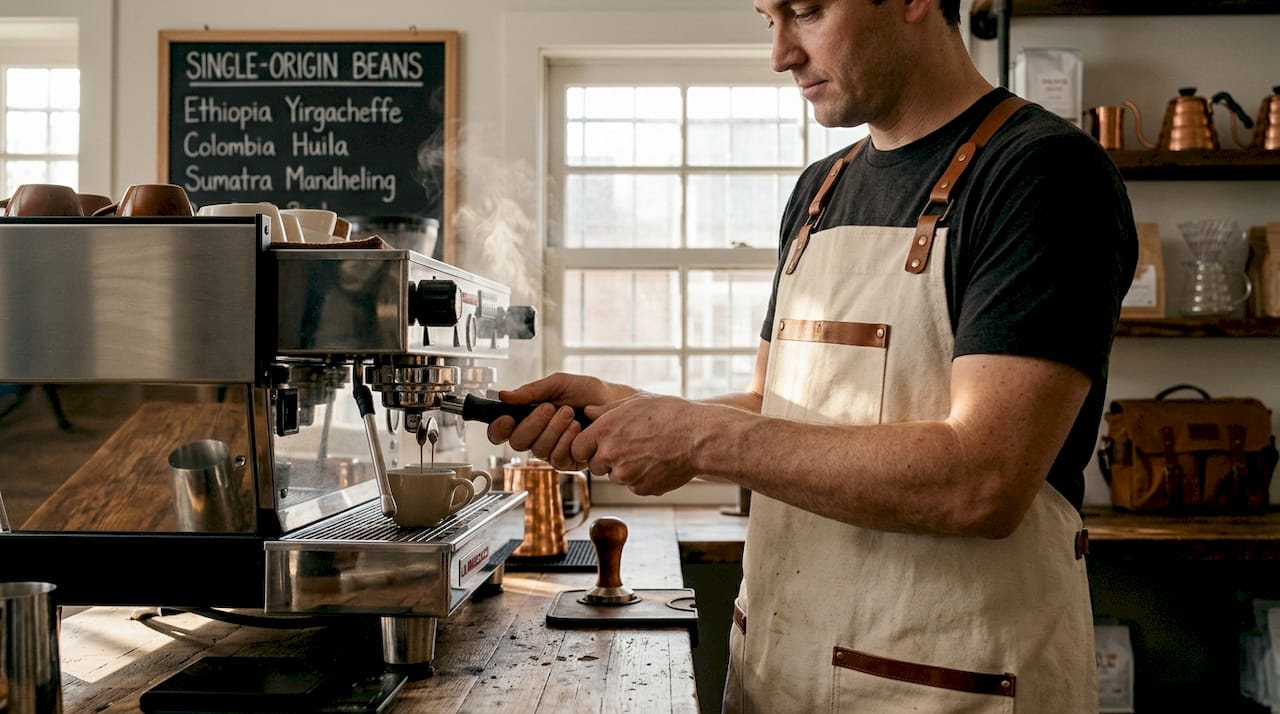
Specialty espresso is defined by its use of defect-free, traceable beans scoring 80 or above on the Specialty Coffee Association cupping scale, roasted to preserve origin character and brewed with precise calibration to highlight complex flavors. Commercial espresso, by contrast, prioritizes volume, uniformity, and cost efficiency, using lower-grade beans often blended with robusta and roasted darker to mask inconsistency. Understanding how specialty espresso differs from commercial is not just a matter of taste preference. It is a matter of measurable quality standards, deliberate craft, and a fundamentally different philosophy about what a shot of espresso should deliver. This guide walks you through each layer of that distinction.
What quality standards separate specialty espresso beans from commercial?
Specialty espresso’s quality is measurable, not subjective. The SCA cupping protocol scores ten sensory attributes including aroma, flavor, acidity, and overall balance, and any coffee falling below 80 points is classified as commercial grade. This scoring system, administered by certified Q Graders under standardized conditions, removes guesswork from the specialty classification. It means when you drink a specialty espresso, you are drinking something that passed a rigorous, documented evaluation.
The defect rules are equally exacting. Specialty-grade green coffee must have zero primary defects and no more than five secondary defects in a 350-gram sample. Primary defects include full black beans, full sour beans, and large stones. Each of these disqualifies the entire lot from specialty classification. Commercial beans carry no such restriction, which is why blends often contain a mix of origins and grades chosen for price and volume rather than flavor integrity.
The flavor consequences of this gap are not subtle. Defects survive roasting and become pronounced under espresso’s concentrated extraction, producing off-notes like fermented sourness or harsh astringency. A skilled barista cannot brew around a defective bean. The quality ceiling is set at the source.
| Quality Factor | Specialty Espresso | Commercial Espresso |
|---|---|---|
| Minimum cupping score | 80+ on SCA scale | Below 80 acceptable |
| Primary defects allowed | Zero | No strict limit |
| Secondary defects allowed | Max five per 350 g | Varies by grade |
| Bean traceability | Single origin or traceable blend | Often anonymous blend |
| Robusta inclusion | Rare, intentional | Common for cost and crema |
- Specialty beans are evaluated by certified Q Graders using standardized SCA protocols
- Commercial beans are graded for commodity markets, not sensory quality
- Robusta adds bitterness and body to commercial blends at lower cost
- Traceable sourcing in specialty coffee allows roasters to match flavor profiles to origin
Pro Tip: When buying espresso beans, look for a cupping score listed on the bag or product page. Any score above 85 indicates exceptional quality and is a reliable signal of flavor clarity.
How do roasting philosophies differ between specialty and commercial espresso?
Roasting is where bean potential is either realized or erased. Specialty roasting targets flavor clarity, sweetness, and distinct origin character through careful, controlled profiles. Commercial roasting goes darker, using heat to mask the variability and defects present in lower-grade beans. The result is a cup that is consistent but flat, heavy on bitterness and body, with little of the brightness or sweetness that defines a well-grown Arabica.
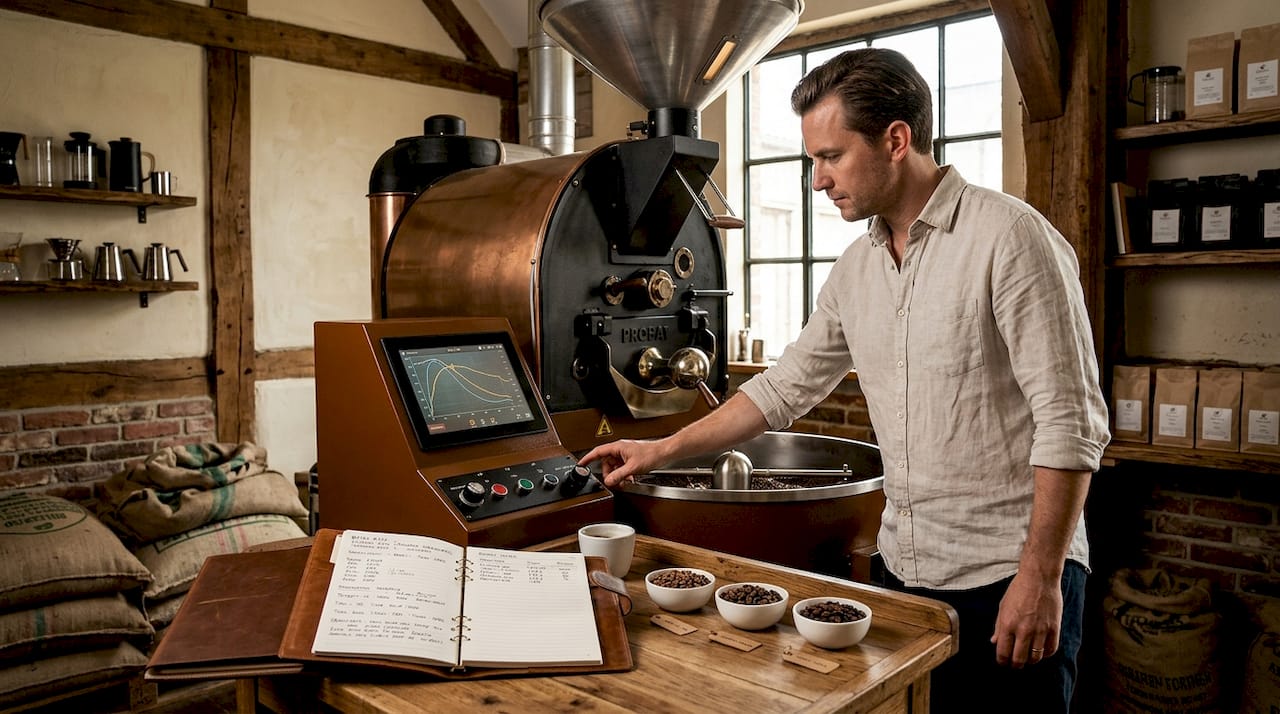
The technical difference lies in how roasters use heat as a precision tool. Roast profile controls espresso solubility, porosity, and extraction kinetics. A specialty roaster working with a washed Ethiopian Yirgacheffe will choose a lighter, more developed profile to preserve the bean’s natural florals and citrus notes. A commercial roaster working with a commodity blend will push the roast darker, where caramelization and carbon dominate and origin character disappears entirely.
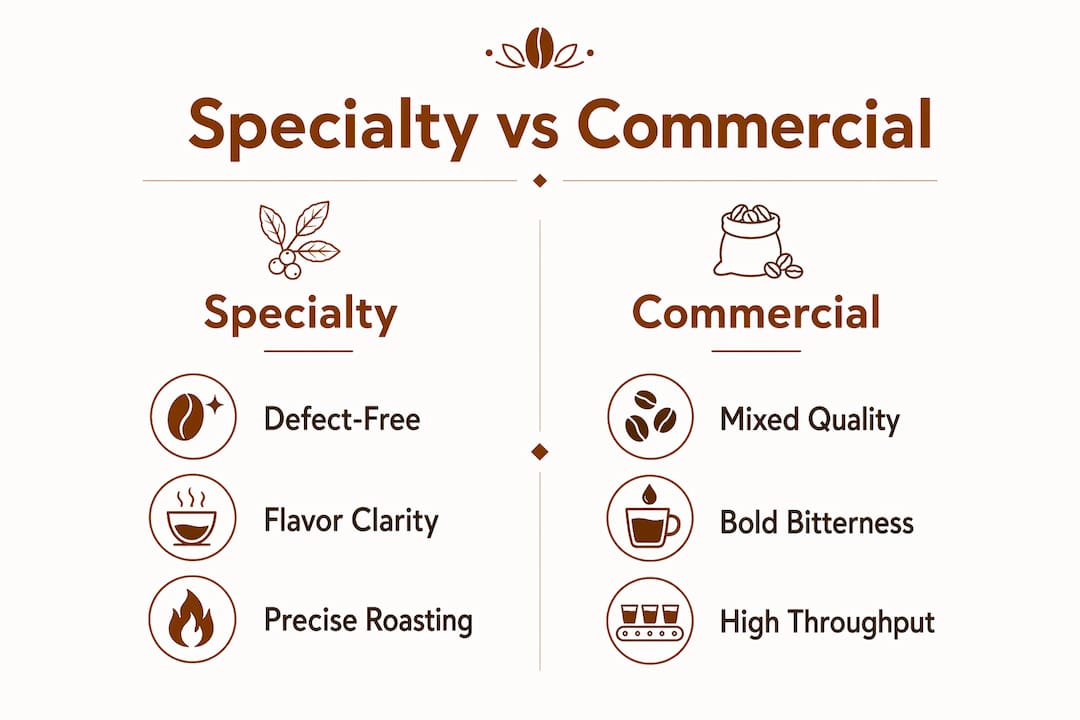
This is not a judgment against darker roasts as a category. Some specialty roasters intentionally roast darker for espresso to achieve chocolate and caramel notes. The difference is intent. Specialty roasters use roast as a technical lever to shape flavor expression. Commercial roasters use darkness as a defect screen and a uniformity guarantee. You can taste that difference in the cup.
| Roasting Approach | Specialty Espresso | Commercial Espresso |
|---|---|---|
| Primary goal | Preserve origin character and sweetness | Achieve uniformity and mask defects |
| Typical roast level | Light to medium, profile-specific | Medium-dark to dark |
| Flavor outcome | Fruity, floral, bright, balanced | Bitter, heavy, uniform |
| Batch size | Small, lot-specific | Large, blended for consistency |
Pro Tip: Ask your roaster for the roast date, not just the roast level. Specialty espresso is best consumed between 7 and 21 days post-roast, when CO2 has degassed enough for even extraction but freshness is still intact.
You can explore how roast level shapes flavor in espresso in detail, from the chemistry of development time to the sensory shifts between a city roast and a full city plus.
In what ways do brewing techniques create distinct specialty espresso flavors?
Espresso brewing forces hot water through finely ground coffee at approximately 9 bar pressure for 25 to 30 seconds, producing a concentrated shot with crema. That much is the same across specialty and commercial settings. What diverges sharply is what happens before and during that extraction.
In specialty practice, dialing-in is a batch-specific calibration. Each new lot requires tuning of grind size, dose weight, yield, and water temperature to balance sweetness, acidity, and bitterness. A single-origin Guatemalan natural processed espresso will demand different parameters than a washed Colombian. Small changes in grind size shift the extraction from sweet and bright to bitter and flat. This is not a one-time setup. It is an ongoing discipline.
Commercial espresso workflows prioritize speed and repeatability. Parameters are set once, often by a regional trainer or equipment technician, and baristas follow them without adjustment. This produces a consistent product across hundreds of locations, which is the commercial goal. But it also means the espresso never reaches the flavor ceiling of its beans, because no one is calibrating for that ceiling.
The flavor outcomes are measurable in sensory terms. Specialty espresso delivers fruity, floral, and bright notes with complexity that changes as the shot cools. Commercial espresso is more bitter and uniform, with a heavier body that stays consistent from the first sip to the last. Neither is wrong for its context. But if you are seeking a sensory experience rather than a caffeine delivery mechanism, the specialty approach is the one built for that purpose.
Here is what precise brewing calibration controls in specialty espresso:
- Grind size determines surface area and extraction speed. Finer grinds extract faster and risk over-extraction bitterness. Coarser grinds under-extract and produce sourness.
- Dose weight controls the coffee-to-water ratio. Specialty baristas weigh doses to the tenth of a gram for consistency.
- Yield is the total weight of liquid espresso in the cup. A 1:2 ratio (18 g in, 36 g out) is common in specialty, but single-origin lots may call for 1:2.5 or higher.
- Water temperature affects solubility of different flavor compounds. Lighter roasts often extract better at slightly higher temperatures.
- Extraction time is the result of all the above variables working together. Specialty baristas adjust the other four to hit the target time, not the other way around.
Understanding brewing parameters and processing methods together gives you a complete picture of why two espressos made from the same machine can taste entirely different.
How do equipment and workflow considerations shape the espresso experience?
Equipment is not neutral. Commercial espresso machines are engineered for throughput, durability, and sustained consecutive shot production across hundreds of pulls per service. They are built to perform reliably under pressure, not to give the barista fine-grained control over each shot. That is the right tool for a high-volume café serving 400 covers at lunch.
Specialty setups prioritize a different set of values. Thermal stability and low retention are the defining features of specialty-grade espresso machines. Temperature fluctuations during high-volume service directly degrade flavor clarity in specialty espresso, because lighter roasts are more sensitive to extraction temperature than darker commercial blends. Specialty cafes choose equipment that minimizes those fluctuations, even at the cost of throughput.
The workflow implications are real. A specialty barista dialing in a new lot may pull and discard several shots before the parameters are right. That process is incompatible with a 200-cover brunch service. This is why equipment and workflow design critically affect whether specialty espresso quality survives high-volume service. The best beans and the most skilled barista cannot compensate for a machine that cannot hold temperature under load.
- Specialty machines: prioritize thermal stability, low group head retention, and barista-adjustable parameters
- Commercial machines: prioritize durability, consecutive shot capacity, and ease of staff training
- Workflow in specialty: slower, calibration-intensive, lot-specific
- Workflow in commercial: faster, standardized, designed for consistency at scale
- Customer experience in specialty: more variable but potentially far more rewarding
- Customer experience in commercial: predictable, familiar, optimized for speed
For a deeper look at how espresso machine features and workflow planning intersect in professional settings, the equipment planning frameworks used in restaurant startups offer useful context on matching machine capability to service volume.
Key takeaways
Specialty espresso differs from commercial espresso through a chain of measurable decisions: defect-free beans, origin-preserving roasts, and batch-specific brewing calibration that commercial workflows are not designed to replicate.
| Point | Details |
|---|---|
| Bean quality is the foundation | Specialty beans score 80+ on the SCA scale with zero primary defects allowed. |
| Roasting intent shapes flavor | Specialty roasters preserve origin character; commercial roasters roast dark for uniformity. |
| Brewing precision is non-negotiable | Specialty espresso requires batch-specific grind, dose, and temperature calibration. |
| Equipment design matters | Thermal stability and low retention define specialty machines; throughput defines commercial ones. |
| Flavor complexity is the outcome | Specialty espresso delivers fruity, floral, and balanced notes; commercial espresso delivers bitterness and uniformity. |
Why the gap between specialty and commercial espresso is wider than most people realize
I have tasted espresso across a wide range of settings, from third-wave specialty cafes to hotel breakfast bars, and the gap is not just noticeable. It is structural. The moment you understand that commercial espresso is engineered to be consistent rather than exceptional, you stop expecting it to taste like what you had at that small-batch roaster in your city. They are solving different problems.
What surprises most enthusiasts is how much of specialty espresso’s character is established before the barista touches the machine. The SCA grading system exists precisely because flavor quality is traceable to the green bean. A barista working with defect-laden commodity coffee cannot dial their way to a clean, sweet shot. The ceiling is set at origin, reinforced at the roastery, and either honored or squandered at the machine.
The challenge I find most interesting is the tension between specialty quality and volume. The dialing-in process that makes specialty espresso extraordinary is also what makes it fragile in high-volume service. The cafes that get it right invest in equipment with genuine thermal stability and train baristas to adjust parameters per lot, not per shift. That commitment is rare, and when you find it, the cup reflects every decision made upstream.
My honest recommendation: learn to read a roast date and a cupping score before you buy. Those two numbers tell you more about what is in your cup than any flavor descriptor on the bag.
— Lily
Discover Maisoncantin’s specialty espresso collection
At Maisoncantin, every espresso begins with specialty-grade Arabica beans that meet SCA standards before a single gram is roasted. We roast in small batches, fresh to order, so the cup you brew carries the full character of the origin rather than the ghost of a warehouse shelf. The Amber Six Espresso is crafted for clarity and balance, with a roast profile designed to highlight sweetness and body without sacrificing brightness. The Sapphire Collection takes that further, curating premium lots for those who treat each shot as a ceremony worth preparing. Explore the full range at Maisoncantin and find the espresso that fits your ritual.
FAQ
What is specialty espresso, exactly?
Specialty espresso uses beans that score 80 or above on the SCA cupping scale, with zero primary defects, roasted to preserve origin character and brewed with precise calibration. It is a measurable classification, not a marketing term.
How does commercial espresso taste different from specialty?
Commercial espresso tends to be more bitter and uniform due to darker roasting and lower-grade blended beans. Specialty espresso delivers fruity, floral, and balanced notes that shift in complexity as the shot cools.
Why does specialty espresso require more brewing precision?
Each specialty lot has a unique flavor profile that responds differently to grind, dose, yield, and temperature. Dialing in those variables per batch is what allows the origin character to come through cleanly rather than defaulting to bitterness.
Can commercial machines brew specialty espresso well?
Commercial machines engineered for throughput often lack the thermal stability needed for lighter-roast specialty espresso. Temperature fluctuations during high-volume service degrade flavor clarity, which is why specialty cafes prioritize machines with stable group head temperatures.
Is specialty espresso always better than commercial?
Specialty espresso is measurably higher quality by grading standards, but “better” depends on context. For a nuanced, origin-forward sensory experience, specialty is the clear choice. For speed, consistency, and volume, commercial espresso is purpose-built and performs exactly as intended.


2 Comments