
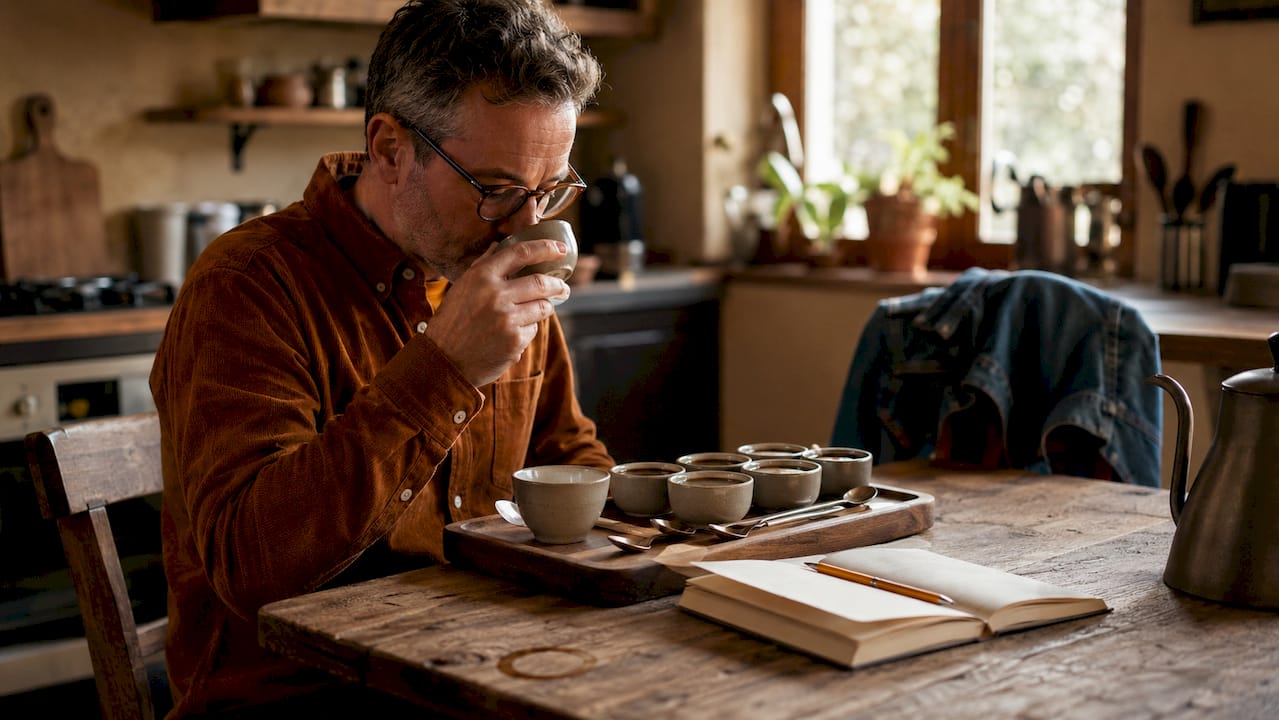
Premium coffee tasting notes describe the natural flavors and aromas found in a coffee bean, reflecting its origin, processing method, and roast level rather than any added ingredients. These descriptors are the language of specialty coffee. They tell you why an Ethiopian Yirgacheffe smells of jasmine, why a Colombian Huila tastes of red apple, and why a Sumatran Mandheling lingers with dark earth and cedar. Understanding premium coffee tasting notes explained through a structured framework transforms every cup from a routine habit into a deliberate sensory experience. This guide breaks down the five core tasting attributes, the SCA Flavor Wheel, practical tasting methods, and the role of origin and roast in shaping what you taste.
1. the five fundamental attributes in coffee tasting notes
Structured tasting methods consistently evaluate five key dimensions to build a complete sensory profile: aroma, acidity, body, flavor, and finish. Each attribute reveals a distinct layer of the coffee’s character. Together, they explain why two cups from the same roaster can taste entirely different.
- Aroma/Fragrance: The smell of dry grounds before brewing and the wet aroma after hot water is added. Floral, fruity, nutty, and spicy scents all appear here. Aroma is often the first and most memorable impression a coffee makes.
- Acidity: Acidity in coffee refers to brightness and liveliness, not sourness. Think citrus zest, green apple, or tamarind. Harsh or flat acidity signals a defect or oxidation, while vibrant acidity is a mark of quality.
- Body: Body is the weight and texture of the coffee on your palate. A light body feels tea-like and clean. A full body feels creamy or syrupy, like whole milk. Brazilian naturals and Sumatran wet-hulled coffees typically produce heavier bodies.
- Flavor Notes: These are the specific taste impressions that emerge mid-sip. Fruity, nutty, chocolatey, floral, spiced. They are not added flavors. They are compounds produced by the bean’s genetics, terroir, and processing.
- Finish/Aftertaste: The finish is what remains on your palate after swallowing. A long, clean finish signals high quality. A short or astringent finish often indicates under-extraction or lower-grade beans.
Pro Tip: Taste each attribute in sequence. Smell the dry grounds first, then the wet grounds, then sip slowly and hold the coffee on your tongue for three seconds before swallowing. This deliberate pace lets each layer reveal itself clearly.
2. how the SCA flavor wheel explains coffee flavor profiles
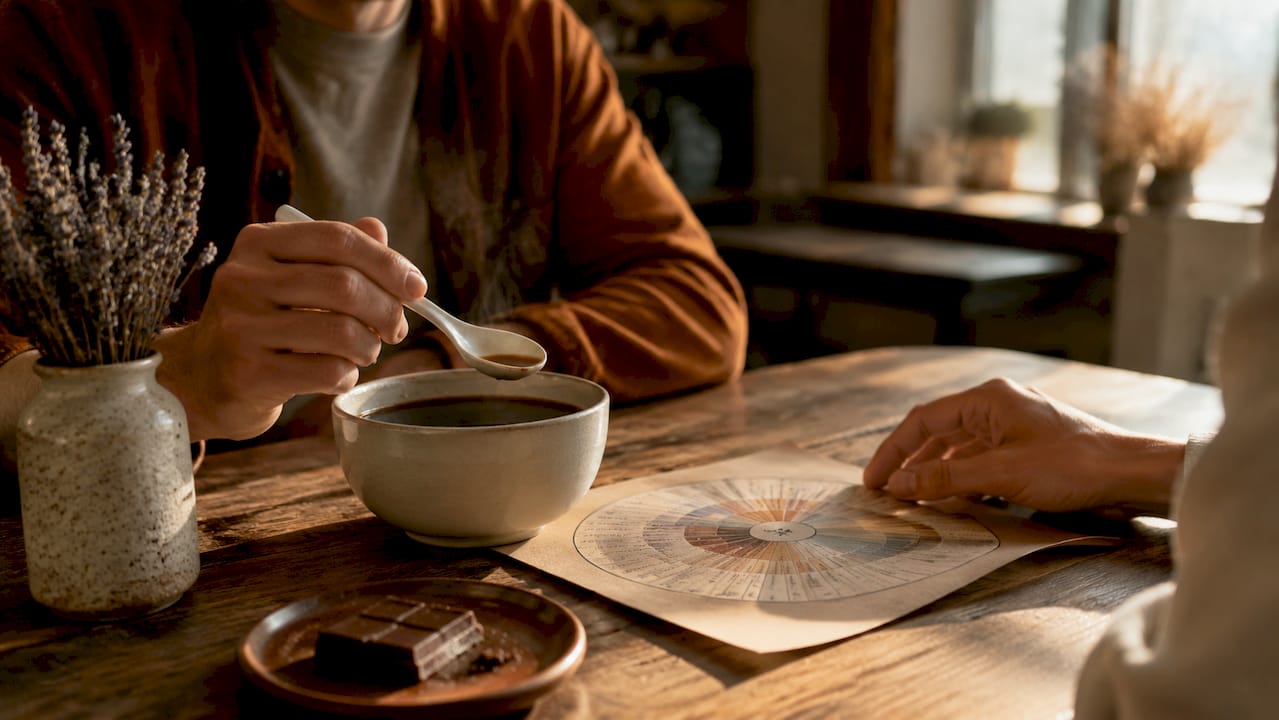
The SCA Flavor Wheel standardizes sensory vocabulary into nine broad flavor categories, each branching into precise subcategories. It was developed in collaboration with World Coffee Research and the SCA Sensory Group, aligning every descriptor with a reference lexicon. This means a taster in Portland and a taster in Tokyo use the same word to describe the same sensation.
The nine broad categories on the wheel are: fruity, floral, sour/fermented, green/vegetative, other, roasted, spices, nutty/cocoa, and sweet. Each category expands outward into more specific descriptors. “Fruity” branches into berry, dried fruit, citrus fruit, and other fruit. “Roasted” branches into pipe tobacco, tobacco, burnt, and cereal.
| Flavor Category | Common Subcategories | Typical Origin Examples |
|---|---|---|
| Fruity | Berry, citrus, dried fruit | Ethiopia, Kenya |
| Floral | Jasmine, rose, chamomile | Ethiopia, Yemen |
| Nutty/Cocoa | Almond, hazelnut, dark chocolate | Brazil, Honduras |
| Roasted | Smoke, cereal, bittersweet chocolate | Dark roasts, Sumatra |
| Spices | Clove, pepper, cinnamon | Indonesia, Guatemala |
| Sweet | Caramel, brown sugar, vanilla | Colombia, Costa Rica |
The wheel also distinguishes between orthonasal aroma (smelling through the nose before sipping) and retronasal aroma (the scent that rises through the back of the throat during swallowing). Both pathways contribute to what you perceive as “flavor.” Most people only pay attention to orthonasal aroma. Training both pathways doubles the information you receive from a single cup.
Flavor descriptors function as a memory map that must be built through direct exposure to real-world references. You cannot recognize jasmine in a cup if you have never smelled jasmine. The wheel gives you the vocabulary. Your experience gives it meaning.
Pro Tip: Build a physical reference kit. Keep a small jar of dried jasmine, a piece of dark chocolate, a dried apricot, and a few roasted hazelnuts near your tasting area. Smell each before you taste. Your brain will make the connection faster than any description can.
3. how to taste coffee and identify flavor notes at home
A standard cupping protocol gives you the most controlled and repeatable way to identify coffee flavor notes. The SCA cupping protocol rates fragrance, aroma, flavor, aftertaste, acidity, body, balance, uniformity, clean cup, sweetness, and overall impression on 0–10 scales. Specialty coffees score 80 or above. That score reflects a measurable sensory standard, not a marketing claim.
Here is a simplified home cupping workflow you can follow today:
- Grind fresh. Use a medium-coarse grind. Measure 10 grams of coffee per 150 milliliters of water.
- Smell the dry grounds. Note any aromas before water touches the coffee. Dry fragrance is often the clearest window into origin character.
- Pour water at 93°C (200°F). Start your timer. Let the coffee steep for four minutes without stirring.
- Break the crust. Push the floating grounds gently with a spoon. Aromas at the crust break are the most distinctive and information-rich of the entire tasting. Inhale slowly and deeply.
- Skim the surface. Remove the remaining grounds and foam with two spoons.
- Slurp at 70°C (158°F). Draw the coffee across your entire palate with a sharp slurp. Aeration amplifies flavor perception significantly.
- Taste again as it cools. Tasting across temperature gradients reveals different notes. Acidity is more pronounced at warmer temperatures. Sweetness emerges as the cup cools.
Essential equipment for a reliable home tasting session:
- A consistent burr grinder (Baratza Encore or similar)
- A kitchen scale accurate to 0.1 grams
- A gooseneck kettle with temperature control
- Two identical ceramic cupping bowls
- A tasting journal or the SCA cupping form
- A copy of the SCA Flavor Wheel for reference
Common pitfalls to avoid: tasting only at one temperature, skipping the dry fragrance step, using pre-ground coffee, and tasting just one origin at a time. Comparative tasting, two or three coffees side by side, trains your palate far faster than tasting in isolation.
4. how origin and processing shape premium coffee flavors
Coffee origin regions produce distinct flavor profiles because climate, soil composition, and altitude all influence how sugars, acids, and aromatic compounds develop inside the bean. A coffee grown at 2,000 meters in Ethiopia develops differently than one grown at 900 meters in Brazil. Altitude slows bean maturation, concentrating sugars and producing more complex acidity and floral character.
| Origin | Typical Flavor Notes | Processing Method |
|---|---|---|
| Ethiopia | Jasmine, blueberry, bergamot | Washed or natural |
| Kenya | Black currant, tomato, bright citrus | Washed (double-fermented) |
| Colombia | Red apple, caramel, hazelnut | Washed |
| Brazil | Chocolate, almond, low acidity | Natural or pulped natural |
| Sumatra | Dark earth, cedar, full body | Wet-hulled (Giling Basah) |
Processing method is the second major variable. Washed coffees remove the fruit before drying, producing clean, bright, origin-forward cups. Natural-processed coffees dry with the fruit intact, adding berry and wine-like complexity. Anaerobic fermentation, a newer method, seals beans in oxygen-free tanks before drying, creating intense tropical fruit and candy-like notes that can be polarizing but are unmistakably distinct.
Roast level transforms or preserves these origin notes in a predictable way. Light roasts preserve the fruit and floral character of the origin. Medium roasts balance origin notes with caramelized sugars. Dark roasts replace origin character with roast-driven notes like smoke, bittersweet chocolate, and ash. When you read a bag of coffee, the roast level tells you how much of the origin story survived the roaster’s decisions. Understanding roast profile impact helps you predict what you will taste before the first sip.
Pro Tip: When exploring a new origin, taste a washed and a natural version of the same region side by side. The contrast isolates the processing variable and makes the origin’s baseline character immediately clear.
Key takeaways
Understanding premium coffee flavor notes requires mastering five sensory attributes, a standardized vocabulary, and a repeatable tasting method applied across diverse origins and roast levels.
| Point | Details |
|---|---|
| Five core attributes | Aroma, acidity, body, flavor, and finish together create a complete sensory profile. |
| SCA Flavor Wheel | Use the nine-category wheel to translate subjective impressions into consistent, shareable language. |
| Cupping protocol | A four-minute steep, crust break, and slurp at 70°C reveals the most flavor information per session. |
| Origin and processing | Region, altitude, and processing method determine the baseline flavor notes before roasting begins. |
| Roast level matters | Light roasts preserve origin character; dark roasts replace it with roast-driven notes. |
What i have learned from years of tasting premium coffee
The first time I sat down with an SCA cupping form, I wrote “tastes like coffee” in the flavor column. That is not a joke. The vocabulary simply was not there yet. What changed everything was not reading more about tasting notes. It was tasting more coffee, deliberately, with reference materials nearby.
The SCA Flavor Wheel is a tool, not a script. I have watched enthusiasts become so focused on finding the “correct” descriptor that they stop actually experiencing the cup. The wheel works best as a starting point, a prompt that directs your attention toward a category. From there, your own memory takes over. If you taste something that reminds you of dried cherries, trust that. You do not need to call it “maraschino” to be right.
The biggest challenge newcomers face is impatience. Palate development is slow and nonlinear. Some days a coffee that tasted like blueberry yesterday tastes like plum today. That is not inconsistency. That is your brain building a more refined map. The solution is to keep tasting, keep noting, and keep comparing. Building a personal tasting journal is the single most underrated practice in this space.
What I find most rewarding is the moment tasting stops feeling like an exercise and starts feeling like a ritual. The cup becomes a pause. A moment of genuine attention in an otherwise distracted day. That shift in perspective is what separates a coffee drinker from a coffee enthusiast.
— Lily
Deepen your tasting practice with Maisoncantin
Maisoncantin sources specialty-grade Arabica beans with the same attention to origin and craft that this guide describes. Every coffee is roasted fresh to order in small batches, preserving the origin character that makes tasting notes worth reading. Whether you are drawn to the bright florals of an Ethiopian natural or the deep cocoa of a Brazilian blend, the Sapphire Collection offers a curated range designed for enthusiasts who taste with intention. For those building their knowledge alongside their palate, the guide on identifying specialty grade Arabica pairs directly with the tasting framework covered here. Each cup from Maisoncantin is an invitation to practice what you have learned.
FAQ
What are coffee tasting notes?
Coffee tasting notes are natural flavor and aroma descriptors that reflect a bean’s origin, processing, and roast. They are not added flavors. They describe compounds already present in the bean.
What does acidity mean in coffee tasting?
Acidity describes brightness and liveliness, not sourness. Positive acidity resembles citrus zest or green apple and is a quality indicator in specialty coffee.
How do i use the SCA flavor wheel?
Start with the broad outer categories and work inward toward specific descriptors. Pair the wheel with real-world reference flavors like fruits, spices, and chocolates to build accurate sensory memory.
Does roast level change the tasting notes?
Yes. Light roasts preserve origin-driven notes like fruit and florals. Dark roasts replace those with roast-driven notes like smoke and bittersweet chocolate.
How many times should i taste a coffee to identify its notes?
Taste the same coffee at least three times across different temperatures in a single session. Flavor perception changes as the cup cools, revealing sweetness and body that heat initially masks.


https://shorturl.fm/42JCz