
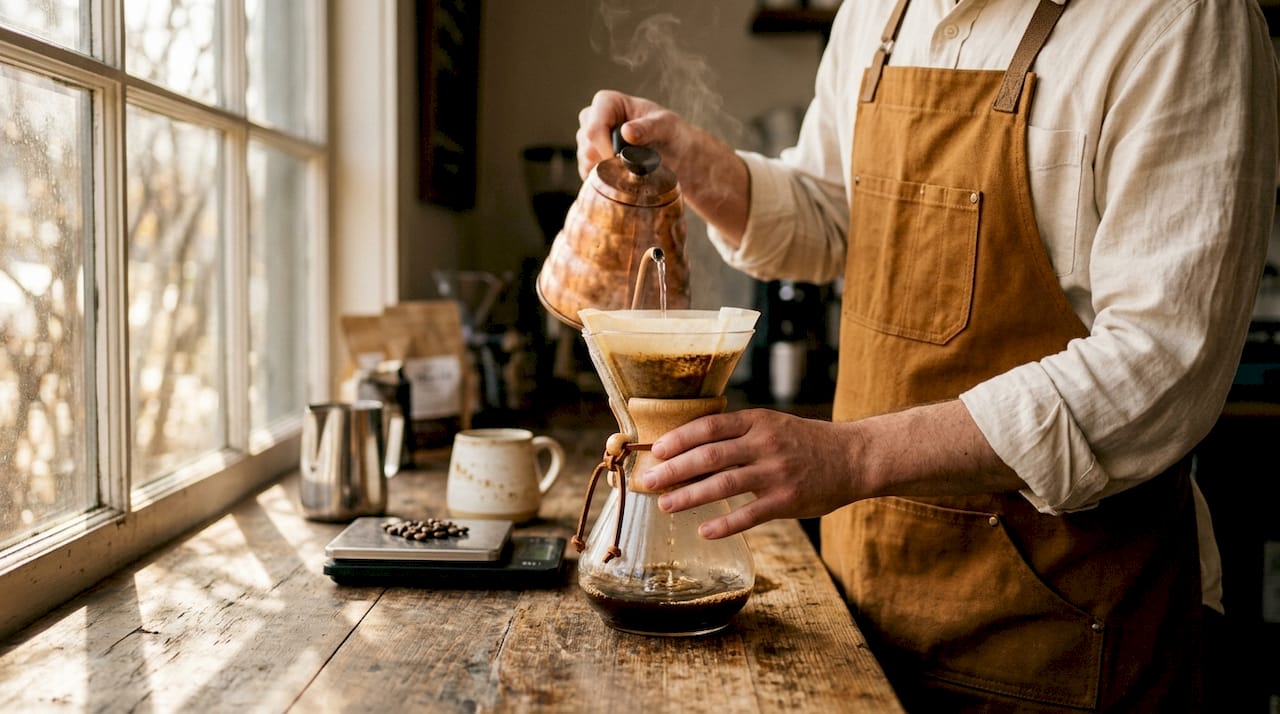
Coffee bloom is defined as the rapid release of carbon dioxide from freshly ground coffee when hot water first makes contact, creating a visible dome of bubbling, swelling grounds. This moment is not decorative. It is the foundation of every well-extracted cup. Most brewers pour water and wait without understanding why, missing the chance to control one of the most consequential variables in their brewing ritual. This guide explains the science behind coffee bloom, why it shapes flavor so directly, and how to use it with intention every time you brew.
What is coffee bloom, and what causes it?
Coffee bloom is caused by CO₂ gas trapped inside roasted coffee beans during the roasting process. When beans are roasted, organic compounds break down and produce carbon dioxide, which becomes locked inside the bean’s cellular structure. Grinding the beans dramatically increases the surface area exposed, which accelerates CO₂ release. The moment hot water touches the grounds, that gas escapes rapidly, creating the characteristic puffing and bubbling you see in the first seconds of brewing.
The chemistry here matters because CO₂ is hydrophobic. It actively repels water. When gas pockets remain inside the grounds, water cannot penetrate evenly, and the result is dry patches that never fully saturate. This is why CO₂ repels water, preventing channeling and uneven extraction before the main brew even begins.
Key factors that determine how dramatic your bloom appears:
- Bean freshness. Beans roasted within 1 to 2 weeks bloom vigorously. Beyond four weeks, the bloom becomes noticeably minimal as CO₂ has already off-gassed naturally.
- Roast level. Darker roasts produce more CO₂ during roasting and tend to bloom more aggressively than light roasts.
- Grind size. Finer grinds expose more surface area, releasing CO₂ faster and producing a more active bloom.
- Water temperature. Ideal bloom temperature sits between 195 and 205°F. Water that is too hot causes aggressive, uncontrolled bloom and risks bitterness. Water that is too cold produces a weak release and leads to sourness.
Understanding roast profiles helps you predict how your specific beans will behave during bloom, which makes every adjustment more deliberate.
Why does coffee bloom matter for flavor?
Bloom is not just waiting for CO₂ to escape. It is the process of establishing reliable water contact with every particle in the bed, creating the capillary pathways that allow even extraction to follow. Without it, water finds the path of least resistance, flows through already-wet channels, and bypasses dry pockets entirely. This is called channeling, and it produces a cup that tastes simultaneously over-extracted in some areas and under-extracted in others.
“Proper bloom sets the foundation for a balanced and flavorful cup. Skipping or rushing it leads to uneven extraction and taste issues like sourness or flatness.” — Breville
The flavor consequences are specific. A cup brewed without adequate bloom often tastes sour, thin, or oddly sharp. The sourness comes from under-extracted acids that escape early when water channels through. The flatness comes from aromatic compounds that never fully dissolved because the grounds were never uniformly saturated. When bloom works correctly, water interacts with coffee oils and aromatics more completely, producing a richer, more layered cup.
The significance of coffee bloom also extends to freshness as a quality signal. Vigorous bloom indicates freshness and maximized flavor potential. Coffee that barely blooms is often older and less flavorful, regardless of how carefully you brew it. This is why sourcing freshly roasted beans is not a preference but a prerequisite for experiencing bloom’s full benefit.
How to achieve coffee bloom: technique and timing
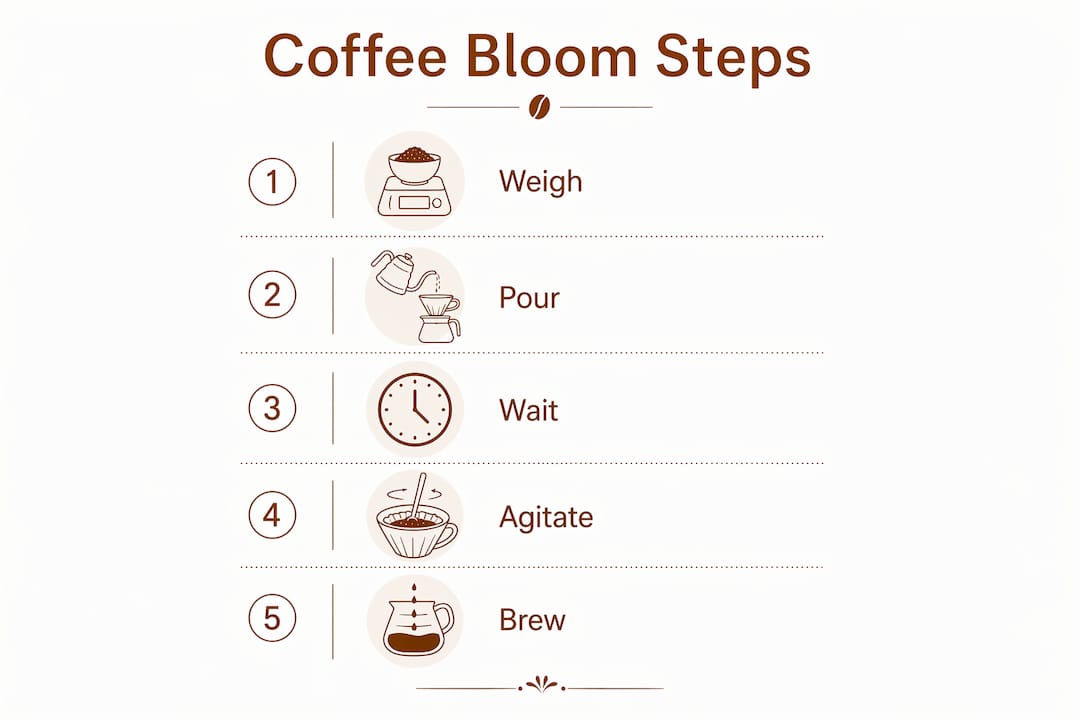
Proper bloom technique is precise and repeatable. The standard approach works across most manual brewing methods and requires only a scale, a timer, and water at the right temperature.
- Measure your coffee. Use a ratio of 1:15 to 1:17 coffee to water by weight as your starting point.
- Heat your water. Bring it to between 195 and 205°F. A gooseneck kettle gives you the control to pour slowly and evenly.
- Start your timer. Begin the moment water touches the grounds.
- Pour the bloom water. Use 2 to 3 times the coffee weight in water. For 20 grams of coffee, pour 40 to 60 grams of water.
- Wait 30 to 45 seconds. This window allows CO₂ to escape fully and the grounds to begin saturating evenly.
- Continue your pour. Proceed with the remaining water in slow, controlled circles.
Pro Tip: Agitation during bloom requires restraint. A gentle swirl of the brewer or a single stir with a spoon lifts and separates particles without pushing fine grounds to the sides of the filter. Over-agitation risks clogging and disrupts the uniform extraction you worked to create.
Adjustments based on your beans matter here. Very fresh beans, roasted within the past week, may need a slightly longer bloom of up to 45 seconds because CO₂ release is more intense. Older beans, or those past the four-week mark, may only need 20 to 25 seconds. Light roasts tend to bloom more quietly and may benefit from a gentle stir to encourage even wetting. Dark roasts bloom aggressively and often need no encouragement at all.
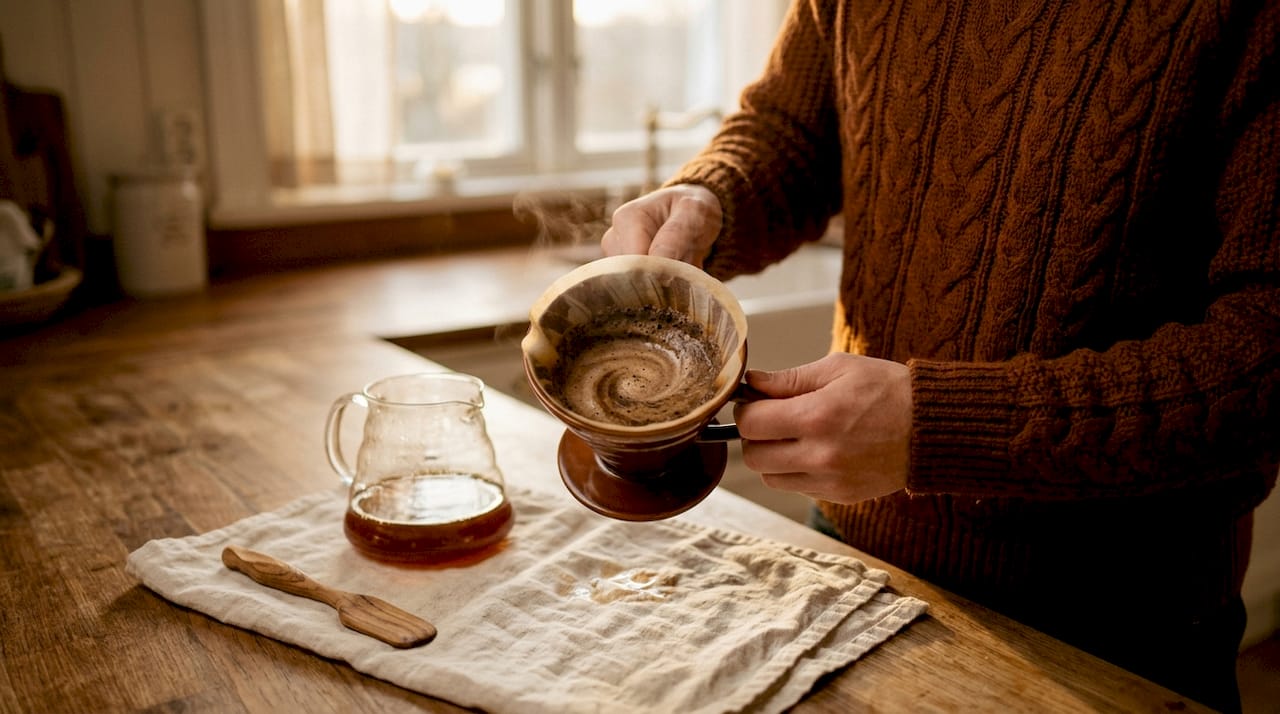
The morning coffee ritual becomes measurably more consistent when you treat bloom as a fixed, timed step rather than an optional pause.
How bloom works across different brewing methods
Bloom behaves differently depending on the brewing method, and adapting your approach to each one produces noticeably better results.
| Brewing method | Bloom visibility | Recommended bloom time | Key consideration |
|---|---|---|---|
| Pour-over (V60, Chemex) | High, dramatic dome | 30 to 45 seconds | Slow, centered pour; gentle swirl optional |
| French press | Moderate, surface bubbling | 30 seconds | Stir gently after pouring bloom water |
| Espresso | Low, subtle expansion | 5 to 10 seconds (pre-infusion) | Pre-infusion setting mimics bloom effect |
| AeroPress | Moderate | 20 to 30 seconds | Invert method allows longer bloom contact |
Pour-over methods like the Hario V60 and Chemex make bloom most visible and most consequential. The open filter bed means channeling is easy to create and easy to see. A well-executed bloom on a V60 produces a symmetrical, domed rise that slowly settles as CO₂ escapes. This is the clearest visual confirmation that your beans are fresh and your technique is working.
French press bloom is less discussed but equally useful. Pouring bloom water over the grounds and waiting 30 seconds before adding the rest allows CO₂ to escape before the full immersion begins. The result is a cleaner, more even extraction with less of the muddy, flat quality that poorly prepared French press coffee can produce.
Espresso bloom is the least visible but still critical. Most modern espresso machines offer a pre-infusion setting, which delivers a small amount of water to the puck before full pressure engages. This functions as a bloom phase. Bloom in espresso affects initial water contact and flavor development, and skipping pre-infusion on fresh beans often produces uneven shots with harsh, channeled flavors.
Key takeaways
Coffee bloom is the single most overlooked variable in home brewing, and correcting it produces an immediate, measurable improvement in cup quality.
| Point | Details |
|---|---|
| Bloom definition | Coffee bloom is CO₂ escaping from freshly ground beans when hot water is applied, creating visible bubbling. |
| Flavor impact | Skipping bloom causes channeling, sourness, and flat flavor from uneven extraction across the coffee bed. |
| Correct technique | Pour 2 to 3 times the coffee weight in water and wait 30 to 45 seconds before continuing your brew. |
| Freshness signal | Vigorous bloom confirms bean freshness; minimal bloom indicates older beans with reduced flavor potential. |
| Method adaptation | Pour-over requires the most attention to bloom; espresso uses pre-infusion as its equivalent bloom phase. |
Why bloom changed the way I think about brewing
by Lily
I spent years treating bloom as a formality. I poured a little water, waited what felt like long enough, and moved on. The cups were fine. Fine is the word that haunts every brewer who has not yet paid attention to the right things.
The shift came when I started timing bloom precisely and weighing my bloom water separately. The difference in the cup was not subtle. Coffees I had written off as too sharp or too thin suddenly had structure. The same beans, the same grinder, the same ratio. Only the bloom changed.
What I have learned since is that bloom reveals the truth about your beans before you even finish brewing. A flat, barely-active bloom tells you something important: the beans are past their peak, and no amount of technique will recover what time has taken. A vigorous, domed bloom tells you the opposite. It tells you that what is in your cup has the potential to be exceptional.
The ritual of bloom is also, I think, the most honest pause in the brewing process. You pour a small amount of water. You wait. You watch. That 30 to 45 seconds is not dead time. It is the moment the coffee prepares itself for you. Learning to read it, rather than rush through it, is what separates a brewer from someone who simply makes coffee.
My personal preference is pour-over, specifically the Hario V60, for exactly this reason. The bloom is visible, responsive, and informative. Every variable shows up in that dome. And when the beans are truly fresh, the rise is almost theatrical.
— Lily
Brew with intention: Maisoncantin’s freshness advantage
The bloom you see in your brewer is only as good as the beans you start with. At Maisoncantin, every bag of specialty-grade Arabica is roasted fresh to order in small batches, which means the CO₂ locked inside those beans is still there when the coffee reaches you. That is the difference between a bloom that rises and one that barely stirs.
For espresso enthusiasts, the Amber Six Espresso is crafted specifically for pre-infusion bloom technique, with a roast profile that rewards patience and precision. For pour-over and French press devotees, the full Maisoncantin product range offers organic blends and single-origin selections chosen for their bloom potential and flavor clarity.
Freshness is not a marketing claim here. It is the reason bloom works. Explore the collection and taste the difference that intentional roasting makes from the very first pour.
FAQ
What is the coffee bloom definition in simple terms?
Coffee bloom is the bubbling and swelling of coffee grounds that occurs when hot water first contacts freshly roasted, ground coffee, caused by the rapid release of trapped CO₂.
Does coffee bloom actually affect flavor?
Yes. Proper bloom allows even water saturation across all grounds, which prevents channeling and produces a balanced, full-flavored cup. Skipping it leads to sourness and flat extraction.
How long should you wait during coffee bloom?
The standard bloom time is 30 to 45 seconds, using water that weighs 2 to 3 times the weight of your coffee grounds, before continuing with the rest of your brew.
Why does my coffee barely bloom?
Minimal bloom usually means the beans are older than four weeks and have already off-gassed most of their CO₂. Fresher beans, ideally roasted within one to two weeks, produce a noticeably more active bloom.
Does bloom work the same way in espresso?
Espresso bloom is less visible but functions through pre-infusion, where a small amount of water saturates the puck before full pressure is applied. This step mirrors the bloom phase in manual brewing and improves extraction evenness.


2 Comments