
A coffee roast profile is the precise time-temperature curve that transforms raw green beans into the cup you know by scent before the first sip. Every flavor note, every degree of acidity, every quality of body traces back to decisions made during roasting, specifically how long the beans develop relative to two audible milestones: first crack and second crack. Understanding roast profiles gives you the vocabulary and judgment to choose coffee with intention, not guesswork. This is coffee roast profiles explained at the level that actually changes how you drink.
What are the main coffee roast levels and how do they differ?
Roast profiles are defined by when the roaster stops the batch relative to first crack, which occurs around 196 to 205°C, and second crack, which begins around 224 to 230°C. These two milestones divide the roasting spectrum into four broadly recognized levels: light, medium, medium-dark, and dark. Each level produces a distinct sensory experience, and none is objectively superior. The right choice depends entirely on what you want in the cup.
| Roast Level | Temperature Range | Flavor Character | Bean Surface |
|---|---|---|---|
| Light | 196–210°C | Bright acidity, floral, fruity, origin-forward | Dry, matte |
| Medium | 210–220°C | Balanced sweetness and acidity, caramel, mild body | Dry to slightly textured |
| Medium-dark | 220–230°C | Chocolate, toasted nuts, low acidity, fuller body | Slight oil sheen |
| Dark | 230°C+ | Smoky, bittersweet, roast-dominant, heavy body | Oily surface |
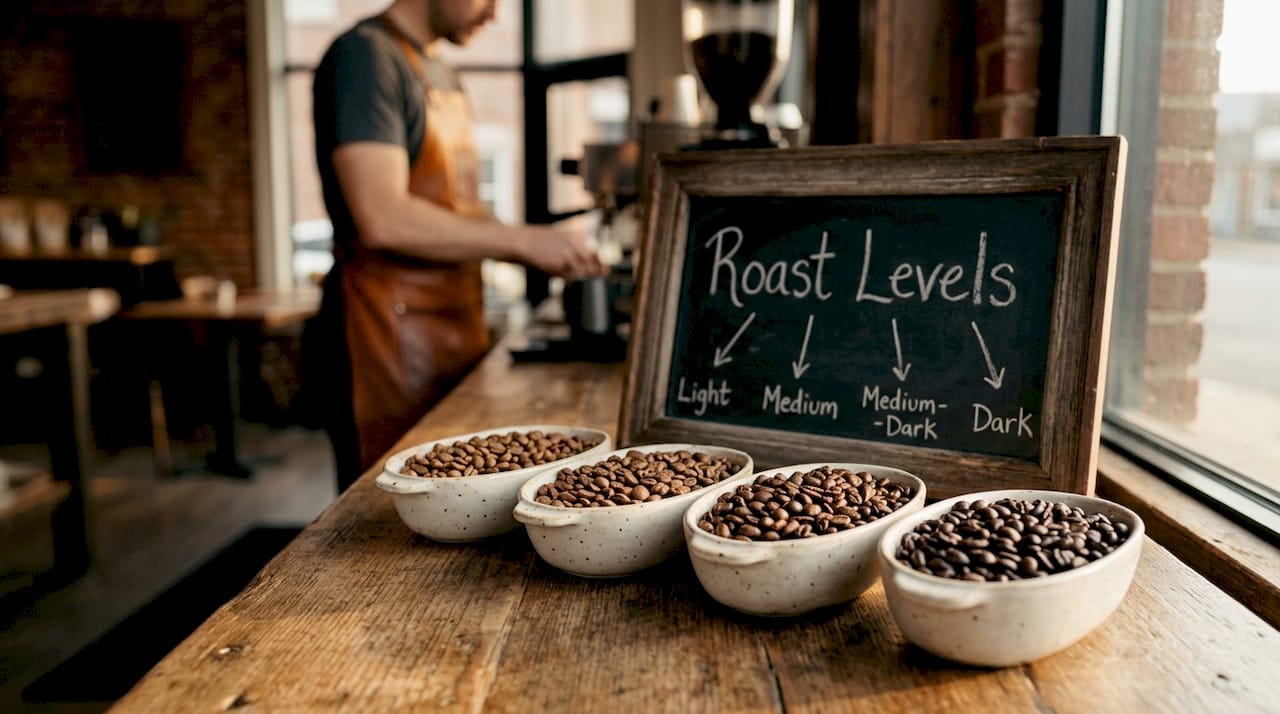
Light roasts highlight origin character with bright acidity and floral or fruity notes, while dark roasts shift the flavor toward roast-derived smokiness and bittersweet depth. This is the central trade-off in every roasting decision: origin clarity versus roast complexity. Medium roasts occupy the most forgiving middle ground, balancing sweetness and acidity without sacrificing either entirely.
Bean appearance tells part of the story. Light roasts have a dry, matte surface because the oils remain locked inside the bean. Dark roasts display a visible oil sheen as prolonged heat forces lipids to the surface. Medium-dark roasts sit between these two states, with a subtle sheen beginning to form.
- Light roast: Best for pour-over, Chemex, and AeroPress. Showcases single-origin Ethiopian or Kenyan beans beautifully.
- Medium roast: Versatile across filter and espresso. Suits Colombian and Brazilian origins well.
- Medium-dark roast: Excellent for espresso and milk-based drinks. Adds body without overwhelming bitterness.
- Dark roast: Suited to French press, cold brew, and espresso blends where roast character is the point.
How do first and second crack control the flavor you taste?
The flavor in your cup is the product of chemistry, not chance. Two reactions drive most of what you taste. The Maillard reaction begins around 150°C, producing hundreds of aromatic compounds responsible for the toasty, caramel, and nutty notes that define medium roasts. Caramelization follows, deepening sweetness and adding complexity. Both reactions accelerate as temperature rises, which is why timing matters so precisely.
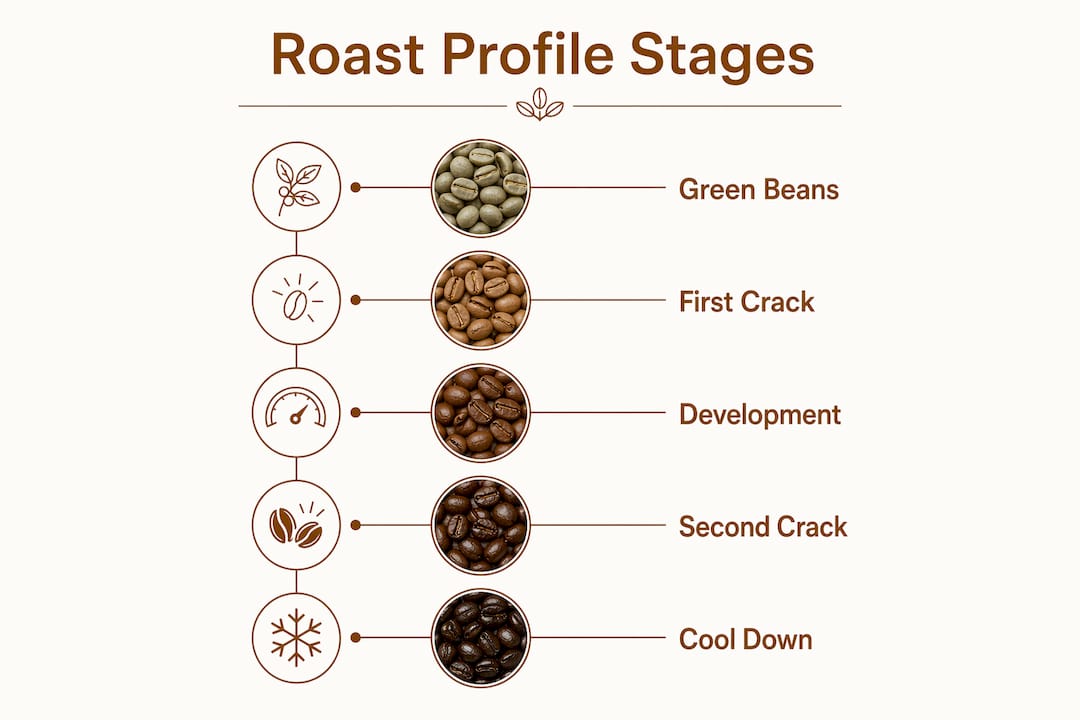
First crack is the roaster’s most important signal. The bean expands, moisture escapes, and you hear a sharp popping sound similar to popcorn. Pulling the batch immediately after first crack produces a light roast with maximum origin clarity and acidity. Extending development time after first crack, without reaching second crack, produces the medium and medium-dark range where sweetness and body build.
Second crack sounds softer and more rapid, like the crackling of a fire. At this stage, the bean’s cellular structure begins to fracture. Roasting into or through second crack produces dark and very dark roasts. The longer the roast extends past this point, the more the origin character disappears and the more the flavor becomes defined by the roast itself.
Common roasting mistakes produce recognizable sensory flaws:
- Underdeveloped roast: Pulled too early, before first crack completes. Tastes grassy, papery, or astringent.
- Baked roast: Roasted too slowly with insufficient heat. Tastes flat, dull, and lacking sweetness or clarity.
- Scorched roast: Excessive heat applied too fast at the start. Produces harsh, acrid bitterness on the front of the palate.
- Over-roasted: Extended past second crack into carbonization. Tastes ashy, hollow, and one-dimensional.
Pro Tip: If your light roast tastes grassy rather than fruity, the beans were likely underdeveloped. Ask your roaster about their development time ratio, the percentage of total roast time spent after first crack. A ratio below 20% often signals underdevelopment.
Understanding these failure modes transforms you from a passive consumer into a discerning one. You can name what went wrong and seek better.
Why are roast labels so inconsistent and what should you trust instead?
Roast naming conventions have no universal standard. Terms like “City+,” “French,” and “espresso roast” carry different meanings depending on the roaster, the region, and the decade the terminology was popularized. A “dark roast” from one specialty roaster may be lighter in development than a “medium roast” from a commercial brand. This inconsistency is not accidental. It reflects the absence of any governing body that standardizes roast nomenclature across the industry.
“Espresso roast” is perhaps the most misleading label in coffee retail. It implies a specific roast level suited to espresso machines, but espresso roast is largely a marketing term with no standardized definition. Any roast level can be used for espresso. The label tells you more about a brand’s positioning than about the bean’s actual development.
Specialty coffee educators advise relying on objective descriptors rather than marketing names when selecting a roast. Here is what to look for instead:
- Roast date: Freshness matters more than the label. Beans roasted within the past two to four weeks deliver peak flavor.
- Origin and variety: A light-roasted Ethiopian Yirgacheffe and a light-roasted Guatemalan Huehuetenango taste nothing alike. Origin shapes the flavor ceiling; roast shapes how much of it survives.
- Sensory descriptors: Tasting notes like “jasmine, lemon, and peach” tell you far more than “light roast” alone.
- Development stage language: Roasters who use terms like “first crack finish” or “development time ratio” are communicating with precision. That precision signals craft.
Treat roast labels as a rough orientation, not a specification. The details always tell a richer story.
How do roast profiles pair with brewing methods for the best cup?
Brewing method and roast level are not independent variables. They interact directly, and mismatching them produces results that neither the bean nor the equipment deserves. Light roasts taste sour when brewed as espresso because the high acidity amplifies under the pressure and concentration of espresso extraction. The result is a sharp, unpleasant shot that leads many drinkers to blame the bean when the real issue is the pairing.
Filter methods, including pour-over, Chemex, Hario V60, and AeroPress, suit light and medium-light roasts because they allow the delicate origin character to express itself without the intensity of pressure extraction. The slower, gentler extraction highlights floral and fruity notes that would be lost or distorted under espresso conditions.
Light and medium roasts transfer approximately 80% of their phenolics and flavonoids into espresso, which means they carry significant sensory and nutritional complexity. This makes them worth exploring in espresso when the recipe is dialed in correctly, but they demand more precision than darker roasts.
Practical pairing guidance by brewing method:
- Pour-over (V60, Chemex): Light to medium roast. Water temperature 92 to 96°C. Highlights acidity and origin clarity.
- AeroPress: Medium to medium-dark roast. Flexible with water temperature. Produces clean, concentrated cups.
- Espresso machine: Medium to medium-dark roast. Water temperature 90 to 93°C. Delivers balance and crema stability.
- French press: Medium-dark to dark roast. Full immersion suits heavier body and lower acidity.
- Cold brew: Dark roast. Extended extraction at room temperature softens bitterness and amplifies chocolate notes.
Pro Tip: When switching to a lighter roast for espresso, lower your water temperature to 88 to 90°C and extend your pre-infusion time. This slows extraction and reduces the sourness that comes from under-extracted acids in a high-acidity bean.
Grind size also shifts with roast level. Darker roasts are more brittle and grind finer at the same setting, so you may need to adjust your grinder coarser when moving from light to dark. This small calibration prevents over-extraction and the bitterness that follows.
Key takeaways
The roast profile, defined by temperature timing relative to first and second crack, is the single most powerful determinant of coffee flavor, aroma, and brewing suitability.
| Point | Details |
|---|---|
| Roast milestones define flavor | First crack at 196 to 205°C and second crack at 224 to 230°C mark the key development stages. |
| Light roasts favor filter methods | Pour-over and AeroPress extract origin clarity; espresso amplifies sourness in light roasts. |
| Labels are unreliable guides | Terms like “espresso roast” lack universal standards; trust sensory descriptors and roast dates instead. |
| Chemical reactions build flavor | The Maillard reaction and caramelization create the sweetness, body, and aroma in every cup. |
| Grind and temperature must follow roast | Adjust grind coarseness and water temperature when changing roast levels to maintain extraction balance. |
Why I stopped trusting roast labels and started listening to the beans
I spent years ordering coffee by label. Dark for mornings, light for afternoons, medium when I could not decide. The results were inconsistent, and I blamed my equipment. Then I started paying attention to the actual roast date, the origin, and the development descriptors. Everything changed.
Bean color alone is unreliable for identifying roast level. Professional roasters rely on audible cracks and roast curve timing because color varies with bean density, moisture content, and equipment. Two beans that look identical can taste completely different. This is the insight that reframes everything: roasting is a process you hear and measure, not one you see.
I also learned to match roast to method before I matched roast to mood. A beautifully developed medium roast from a specialty coffee guide brewed in a V60 at the right temperature is a different experience entirely from the same bean pulled through an espresso machine without adjustment. The roast profile is only half the equation. Your brewing method completes it.
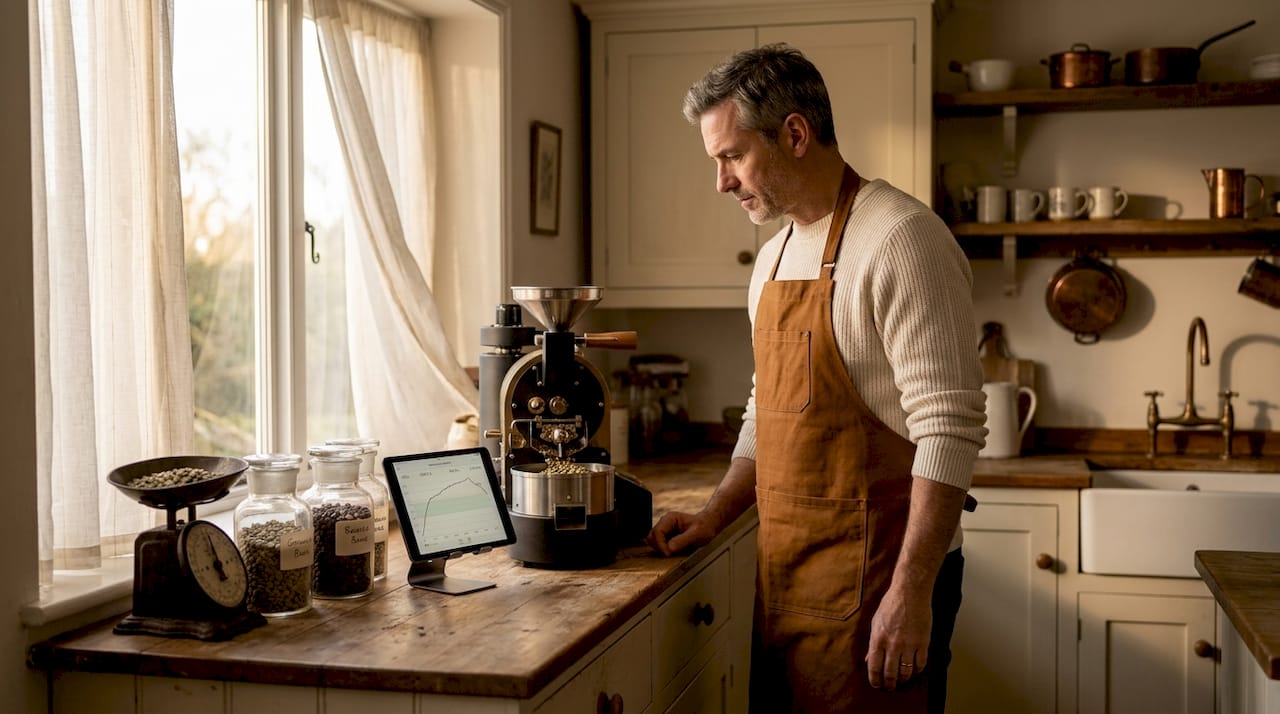
Modern countertop roasters now make home roasting genuinely accessible, with predefined profiles for consistency and customizable curves for those who want to experiment. If you have ever been curious about roasting at home, the barrier is lower than it has ever been. Start with a single-origin green bean and a defined light roast profile. The first crack will tell you everything.
The most important shift is this: stop asking “what roast do I like?” and start asking “what flavor do I want in this moment?” The roast profile is the answer to that second question. Learn to read it, and every cup becomes a deliberate choice.
— Lily
Discover your roast profile with Maisoncantin
Maisoncantin roasts every order fresh, in small batches, so the roast profile you read about here is the one you actually taste in the cup. Each coffee in the Maisoncantin collection is selected to demonstrate a distinct roast character, from the bright acidity of a carefully developed light roast to the deep, composed richness of a medium-dark blend. The Sapphire Collection is a particularly refined starting point for enthusiasts exploring light to medium profiles, showcasing origin clarity at its most expressive. Pair any selection with the detailed brewing guides on the Maisoncantin site to apply everything you have learned here, and transform your next cup into something worth pausing for.
FAQ
What is a coffee roast profile?
A coffee roast profile is the time-temperature curve applied during roasting, defined by how the bean develops relative to first crack at 196 to 205°C and second crack at 224 to 230°C. It determines the flavor, aroma, body, and acidity of the final cup.
How do light and dark roasts differ in flavor?
Light roasts preserve origin character with bright acidity and floral or fruity notes, while dark roasts produce smoky, bittersweet flavors with heavier body and low acidity. The further a roast develops past first crack, the more roast-derived flavors replace origin-derived ones.
Why does my light roast espresso taste sour?
Sourness in light roast espresso comes from high acidity amplified under espresso pressure and concentration. Light roasts suit filter methods better; if you use them for espresso, lower your water temperature to 88 to 90°C and extend pre-infusion to reduce under-extraction.
Can I trust roast labels like “French roast” or “espresso roast”?
Roast labels have no universal standard and vary widely between roasters and regions. Rely instead on the roast date, origin, sensory descriptors, and development stage language for a more accurate picture of what is in the bag.
What brewing method suits each roast level?
Light roasts perform best in pour-over and AeroPress; medium roasts work well across filter and espresso; medium-dark roasts suit espresso and milk-based drinks; dark roasts are ideal for French press and cold brew. Matching roast to method is the single most effective way to improve cup quality.


4 Comments