
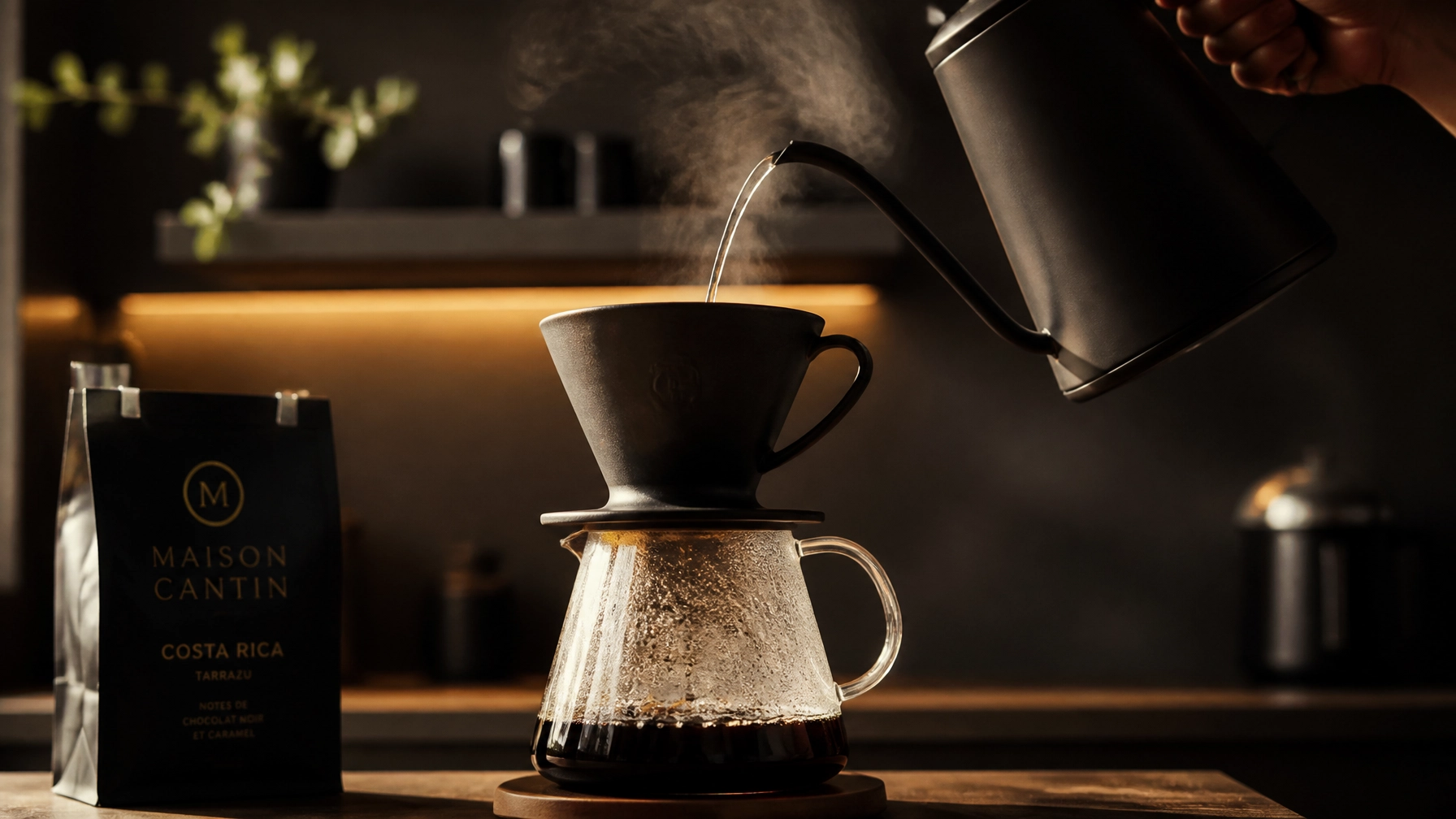
Most people view coffee as a utilitarian jolt of caffeine, a chemical necessity to survive the morning. At Maison Cantin, we believe coffee is a ceremony. It is a mindful pause, a tactile ritual, and a craft that rewards those who pay attention.
If your home brew tastes thin, overly bitter, or "muddy" compared to what you experience at a high-end cafe, the issue isn't your palate. It is your process. Bridging the gap between amateur habits and professional standards requires moving away from guesswork and toward technical precision.
To brew a truly exceptional cup, you must master the variables of extraction. Here is how to transform your kitchen into a professional-grade laboratory for specialty coffee beans.
The Foundation: Freshness and Quality
You cannot brew great coffee from dead beans. Most grocery store coffee is roasted months before it hits the shelf, arriving in a state of chemical stagnation. For the best results, you need fresh roasted coffee delivery from small batch coffee roasters who prioritize quality over volume.
Freshness Window: Coffee is a perishable agricultural product. It peaks between 7 and 21 days after roasting. During this time, the CO2 trapped inside the bean is still degassing, which creates the "bloom" you see during brewing. Beyond 30 days, the delicate volatile oils oxidize, leading to a flat, stale flavor.
The Bean Choice:
- Amber Italian Reserve: Ideal for those seeking a deep, chocolatey body with low acidity.
- Sapphire Bali Blue: A premium choice for those who appreciate the earthy, complex notes of high-altitude Indonesian Arabica.

1. Precision via the Scale
Stop using scoops. Volume is an unreliable measurement because different roasts have different densities. A light-roast bean is denser and smaller than a dark-roast bean. To achieve consistency, you must use a digital scale and measure by weight in grams.
The Golden Ratio: For most manual brewing methods (Pour-over, Chemex, Aeropress), the industry standard is a 1:16 or 1:17 ratio.
- 1:16 Ratio: 20g of coffee to 320g of water. This yields a full-bodied, intense cup.
- 1:17 Ratio: 20g of coffee to 340g of water. This creates a lighter, more tea-like clarity that highlights floral notes.
2. Water: The Silent Solvent
Your coffee is 98% water. If your water tastes like chlorine or minerals, your coffee will too. Use filtered water, never distilled (which lacks the minerals needed for extraction) and never straight from the tap.
The Temperature Rule:
The Specialty Coffee Association (SCA) recommends a water temperature between 195°F and 205°F (92°C–96°C).
- Too Hot (>212°F): You will scald the grounds, extracting harsh, ashy bitterness.
- Too Cold (<190°F): The water won't have enough energy to dissolve the sugars and acids, resulting in a sour, thin, and underdeveloped cup.
Pro Tip: If you don't have a temperature-controlled kettle, bring your water to a boil and let it sit for 60 seconds before pouring. This typically brings it into the 200°F range.
3. The Grind: Surface Area Management
Grinding your coffee immediately before brewing is the single most effective way to improve flavor. Once ground, the surface area increases exponentially, leading to rapid oxidation and flavor loss.
Uniformity Matters: A cheap blade grinder creates "boulders" and "fines", some particles are too big (under-extracted/sour) and some are too small (over-extracted/bitter). Invest in a burr grinder to ensure a consistent particle size.
| Brew Method | Grind Size Consistency | Visual Comparison |
|---|---|---|
| Espresso | Fine | Powdered sugar |
| Pour-Over | Medium | Table salt / Kosher salt |
| French Press | Coarse | Sea salt / Breadcrumbs |
| Cold Brew | Extra Coarse | Cracked peppercorns |

4. Master the Pour (The Bloom)
When you first pour water over fresh grounds, they will bubble and expand. This is the bloom. The release of CO2 is essential; if you don't allow the gas to escape, it will repel the water and prevent even extraction.
The Process:
- Saturate: Pour twice the weight of the coffee in water (e.g., 40g of water for 20g of coffee).
- Wait: Let it sit for 30–45 seconds. You will see the "crust" rise and bubble.
- Continue: Gently pour the remaining water in concentric circles, avoiding the very edges of the filter.
Common Mistakes to Avoid
- Using Boiling Water: High heat destroys the nuanced aromatics of specialty coffee beans.
- Eyeballing the Water: Even a 20ml difference can shift the TDS (Total Dissolved Solids) enough to ruin the balance.
- Poor Storage: Never store coffee in the fridge or freezer. Moisture and odors will permeate the beans. Use an opaque, airtight container in a cool, dark cupboard.
- Dirty Equipment: Old coffee oils go rancid. Scrub your carafes and grinders regularly.
Honest Take: Is it Worth the Effort?
I used to be a "press the button and walk away" coffee drinker. I thought the talk about ratios and "blooming" was elitist posturing. Then I tasted a properly extracted Sapphire Bali Blue side-by-side with a standard drip cup. The difference wasn't subtle; it was a completely different beverage. One was a brown liquid that needed sugar to be palatable; the other had notes of dark chocolate and cedar that lingered like a fine wine. The 10 minutes I spend on my morning ritual now provide more clarity and focus than any 30-second machine brew ever could.
Elevate Your Ritual
At Maison Cantin, we do the hard work of sourcing and roasting so that your only job is the execution. By choosing our freshly roasted selections and applying these technical standards, you aren't just making a drink, you are mastering a craft.

FAQ: Home Brewing Essentials
What is the best coffee-to-water ratio?
For a balanced cup, start with a 1:16 ratio (1 gram of coffee for every 16 grams of water). Adjust to 1:15 for a stronger brew or 1:17 for more clarity.
Does water quality really matter?
Yes. Coffee is mostly water. Use filtered water to ensure no chlorine or high mineral content interferes with the extraction of the coffee’s natural oils.
Should I buy whole bean or ground?
Always buy whole bean if you have a grinder. Ground coffee loses its peak flavor within 15–20 minutes of exposure to air. If you don't have a grinder, our Amber Italian Reserve Ground is roasted and ground to order to maximize freshness.
Why does my coffee taste sour?
Sourness is usually a sign of under-extraction. This happens if your grind is too coarse, your water is too cold, or your brew time was too short.
Why does my coffee taste bitter?
Bitterness is a sign of over-extraction. This occurs if your grind is too fine, your water is too hot, or you brewed for too long.


https://shorturl.fm/RC9pu