
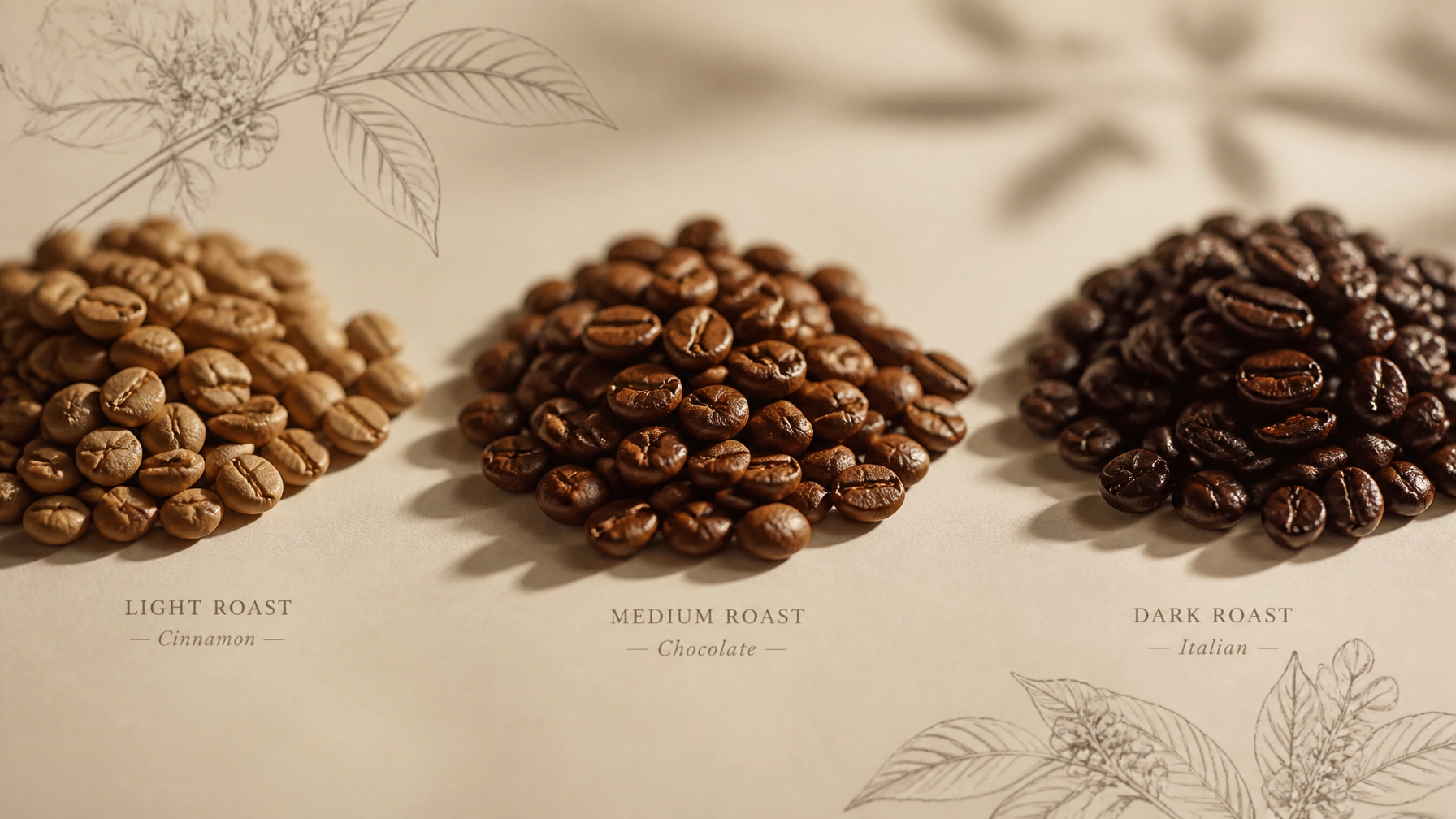
Roasting is the bridge between the raw potential of a green coffee seed and the complex liquid in your cup. It is where chemistry meets craftsmanship. To the uninitiated, coffee is just "black coffee." To the connoisseur, the roast level is the primary indicator of how a coffee will behave, how it should be brewed, and ultimately, how it will taste.
At Maison Cantin, we approach roasting as a precise science. We don't just "cook" beans; we develop them to highlight specific characteristics of their origin or to create a specific sensory experience. If you are still buying coffee based on the color of the bag rather than the profile of the roast, you are leaving your morning ritual to chance.
This guide will dismantle the myths surrounding roast levels and provide you with the technical knowledge required to select specialty coffee beans that match your palate and your brewing equipment.
The Spectrum of Development
The roasting process is a journey through heat and time. As green beans are heated, they undergo the Maillard reaction, a chemical reaction between amino acids and reducing sugars that gives browned food its distinctive flavor. The longer the beans stay in the roaster, the more their internal structure breaks down and their chemical composition shifts from "origin-forward" to "roast-forward."
1. Light Roast: The Purist’s Expression
Light roasts are removed from the roaster immediately after the "First Crack" (the point where the beans physically expand and emit a popping sound, typically around 380°F – 400°F). These beans are light brown, tan, and have a dry, matte surface.
- Flavor Profile: Expect high acidity, bright floral notes, and crisp citrus or berry flavors. You are tasting the "terroir", the soil, climate, and elevation where the bean was grown.
- Body: Thin and tea-like.
- Best For: Filter methods such as Pour-over, Chemex, or V60.
Pro Tip: If you find light roasts too "sour," check your water temperature. Use water at 205°F to ensure you are extracting enough sweetness to balance the natural acidity.

2. Medium Roast: The Balanced Standard
Medium roasts are the "sweet spot" for many specialty drinkers. They are roasted until just before the second crack. The beans are a rich chocolate brown and usually remain dry, though some may show tiny droplets of oil.
- Flavor Profile: A balance of acidity and body. The bright fruitiness of the light roast begins to transform into caramelized sugars, yielding notes of milk chocolate, toasted nuts, and brown sugar.
- Body: Medium, smooth, and round.
- Best For: Drip machines, AeroPress, and versatile morning cups.
Our Amber Breakfast Arabica is a masterclass in medium roasting. It retains enough origin character to remain interesting while providing the comforting, nutty sweetness that defines a premium morning ritual.
3. Dark Roast: The Bold Traditionalist
Dark roasts are taken past the "Second Crack" (typically 440°F and above). At this stage, the bean's internal cell structure has collapsed, pushing oils to the surface. These beans are dark brown to nearly black and have a glossy, oily sheen.
- Flavor Profile: Low acidity, high bitterness, and smoky, roasty notes. The origin flavors are largely replaced by the flavors of the roasting process: bittersweet chocolate, tobacco, and charred wood.
- Body: Full, heavy, and coating.
- Best For: French Press, Moka Pot, and traditional Espresso.
For those who seek depth and intensity, our Amber Italian Reserve represents the pinnacle of premium Italian roast coffee. It is bold, unapologetic, and designed for those who view coffee as a robust experience rather than a delicate tea.

Comparison Table: Roast Level Characteristics
| Feature | Light Roast | Medium Roast | Dark Roast |
|---|---|---|---|
| Color | Tan / Cinnamon | Milk Chocolate | Dark Brown / Black |
| Surface | Dry / Matte | Mostly Dry | Oily / Glossy |
| Acidity | High / Bright | Moderate / Balanced | Low / Muted |
| Body | Light / Tea-like | Medium / Creamy | Full / Heavy |
| Dominant Notes | Fruit, Floral, Cereal | Nutty, Caramel, Chocolate | Smoky, Spices, Cocoa |
| Extraction Goal | Clarity of Origin | Balanced Sweetness | Texture and Intensity |
The "Caffeine Myth": Darkness Does Not Mean Strength
A common misconception among amateur drinkers is that dark roast coffee has more caffeine. This is factually incorrect.
Caffeine is remarkably stable during the roasting process. Because beans lose mass (water weight) as they roast longer, dark-roasted beans are actually less dense than light-roasted beans.
- If you measure your coffee by scoops (volume): Light roast has more caffeine because the beans are smaller and denser.
- If you measure your coffee by weight (grams): Dark roast has slightly more caffeine because you need more beans to reach the same weight.
Regardless of roast, the "strength" of your coffee is determined by your brewing ratio. Aim for a 1:16 ratio (1 gram of coffee to 16 grams of water) as a professional baseline.
Why Small Batch Roasters Matter
When you buy mass-produced coffee from a grocery store, "Dark Roast" is often used to hide the defects of low-quality beans. Charring the coffee creates a uniform, burnt flavor that masks staleness.
As small batch coffee roasters, Maison Cantin roasts each order fresh. We don't hide behind the roast; we use it to amplify the quality of our specialty-grade Arabica. Whether you choose the bright clarity of a light roast or the syrupy depth of our Amber Italian Reserve, you are receiving beans that were handled with technical precision and care.

Honest Take: My Daily Choice
As someone who spends every day surrounded by the aroma of roasting beans, I often get asked which roast is "best." The truth is, it depends on the time of day.
In the quiet of the morning, I prefer a medium-light roast like our Sapphire Bali Blue. It has a complexity that demands my attention. However, when I want a coffee that cuts through milk or stands up to a heavy breakfast, I reach for the Italian Reserve. Don't let anyone tell you that dark roast is "unsophisticated." When done correctly by a skilled roaster, a dark roast offers a luxurious texture that light roasts simply cannot replicate.
Common Mistakes to Avoid
- Buying Pre-Ground Dark Roast: Dark-roasted beans are more porous and oily, meaning they oxidize and go stale much faster than light roasts. Always buy whole bean and grind seconds before brewing.
- Using Boiling Water on Dark Roast: Boiling water (212°F) will extract the harsh, ashy flavors of a dark roast. Drop your temperature to 195°F for darker profiles to keep the cup smooth.
- Storing Beans in the Fridge: Regardless of roast level, moisture is the enemy. Store your beans in their original valved bag in a cool, dark cupboard. Learn more in our guide on how to choose and store high-quality beans.
Summary: Master Your Selection
- Choose Light for clarity, acidity, and a tea-like experience.
- Choose Medium for the perfect balance of sweetness and familiar "coffee" notes.
- Choose Dark for a heavy body, low acidity, and bold, smoky intensity.
The ritual of coffee is personal. By understanding these technical distinctions, you move from being a passive consumer to a mindful practitioner. Experiment with different roasts, adjust your brewing variables, and discover the profile that elevates your daily ceremony.
FAQ: Frequently Asked Questions
Which roast level is the least bitter?
Light roasts are the least bitter because they have undergone the least amount of carbonization. Bitterness in coffee is often a result of the roasting process or over-extraction during brewing.
Does dark roast coffee cause more heartburn?
Actually, dark roast coffee is often easier on the stomach for some people. Research suggests that darker roasts contain a compound that helps prevent hydrochloric acid from building up in the stomach, unlike lighter roasts which have higher concentrations of N-alkanoly-5-hydroxytryptamides.
Is "Espresso Roast" a specific roast level?
"Espresso Roast" is not a standardized level, but it typically refers to a medium-dark to dark roast. These roasts are chosen because they produce the heavy body and crema required for a traditional espresso shot. However, any roast can be brewed as espresso.
Can I use a light roast in a French Press?
Yes, but you must adjust your technique. Use a finer grind than you would for a dark roast and extend your steep time to 5 or 6 minutes to ensure full extraction of the denser, light-roasted beans.