
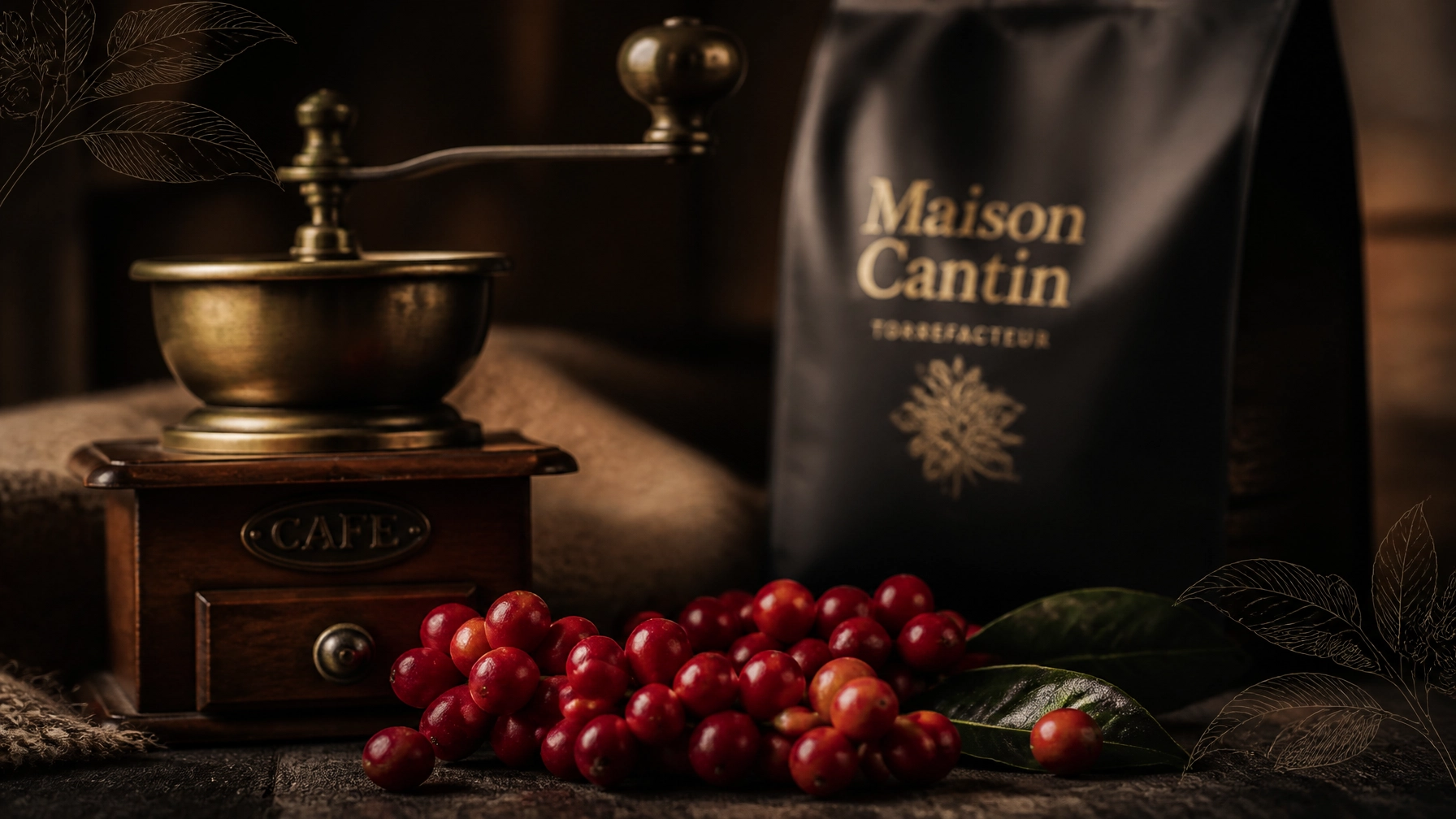
Coffee is not merely a beverage; it is a global narrative of transformation. From its origins as a wild berry in the Ethiopian highlands to its status as a cornerstone of the modern "mindful morning," the journey of the bean is one of constant refinement. At Maison Cantin, we view ourselves as the current stewards of this long-standing tradition, prioritizing the ritual of the pause over the rush of consumption.
To truly appreciate the specialty-grade Arabica in your cup today, one must understand the centuries of craftsmanship that preceded it.
The Ethiopian Genesis: The Dancing Goats and the First "Energy Food"
The story begins in the 9th century in the Kaffa region of Ethiopia. Legend tells of a goatherd named Kaldi who observed his flock becoming unusually energetic after consuming the bright red berries of a specific evergreen shrub.
While the "dancing goats" story is the most famous, the historical reality is even more fascinating. The Oromo people of Ethiopia were likely the first to recognize coffee’s power, mixing ground coffee cherries with animal fat to create nutrient-dense "power balls" for long journeys. This was coffee in its most primal form: raw, functional, and deeply tied to the land.
Pro Tip: Modern coffee enthusiasts often overlook the "cherry" (the fruit surrounding the bean). In Ethiopia, the dried husks are still used to make a tea called qisher, a reminder that every part of this plant has value.
The Arabian Peninsula: From Medicine to Social Masterpiece
By the 15th century, coffee had crossed the Red Sea into Yemen. It was here that the bean moved from a portable food source to a brewed beverage. Sufi monks used the drink, which they called qahwah, to maintain focus during late-night religious devotions.
Yemen also gave us the first commercial cultivation and the legendary port of Mocha. It was in the vibrant cities of the Ottoman Empire that the first coffeehouses (qahveh khaneh) emerged. These weren't just places to drink; they were "Schools of the Wise," centers for chess, political debate, and music.

The European Explosion and the "Bitter Invention of Satan"
When coffee arrived in Venice in the early 17th century, it was initially met with suspicion. Some clerics labeled it the "bitter invention of Satan." However, after Pope Clement VIII tasted it and gave his blessing, the beverage conquered Europe.
The London coffeehouses of the 1600s and 1700s became the breeding ground for the Enlightenment. Lloyd’s of London, the world’s leading insurance market, actually started as a coffeehouse where merchants gathered to share shipping news.
The Evolution of the "Waves": From Commodity to Craft
To understand where Maison Cantin stands today, we must categorize the three major shifts, or "waves", in coffee history:
| Feature | First Wave (1800s – 1960s) | Second Wave (1970s – 1990s) | Third Wave (2000s – Present) |
|---|---|---|---|
| Primary Goal | Mass availability and convenience | Branding and social experience | Transparency and flavor nuance |
| Common Form | Canned, pre-ground, or instant | Espresso-based milk drinks | Single-origin, manual pour-overs |
| Key Priority | Low price and shelf-life | Dark roasts and "latte art" | Terroir, variety, and ethical sourcing |
| Roast Level | Often inconsistent or burnt | Deep, oily dark roasts | Light to medium-dark (flavor focused) |
The First Wave: The Era of Convenience
This era was defined by brands like Folgers and Maxwell House. Coffee was a commodity, often stale and bitter, valued only for its caffeine.
The Second Wave: The Rise of the Café
Led by the explosion of chains like Starbucks, this wave introduced the public to "specialty" drinks. However, the focus remained on the experience of the shop rather than the technical quality of the bean itself.
The Third Wave: The Connoisseur’s Choice
This is where coffee is treated like fine wine. It emphasizes specialty-grade Arabica, transparent trade, and precise roasting. At Maison Cantin, we operate at the pinnacle of this wave, moving beyond simple consumption into the realm of a curated ritual.

Modern Refinement: The Maison Cantin Standard
Today, we are seeing the emergence of what some call the "Fourth Wave", a focus on health-conscious, functional, and ultra-premium selections. Our Amber Mushroom Coffee is a testament to this, blending ancient wisdom with modern science to provide focus without the jitters.
We prioritize the following three pillars to ensure our coffee honors its 1,000-year history:
- Freshness Above All: Unlike grocery store coffee that sits on shelves for months, we roast every order fresh. Oxidized coffee is the enemy of flavor.
- Specialty-Grade Arabica: We exclusively use Arabica beans, which contain more complex sugars and oils than the cheaper, bitter Robusta variety.
- The Ritual of Preparation: Whether you use our Sapphire Bali Blue pods for a quick morning pause or a manual pour-over for a slow weekend, we provide the quality necessary for a meaningful experience.
Common Mistake: Thinking "Darker" Means "Stronger"
Many people believe a dark roast has more caffeine. In reality, roasting longer actually burns off some of the caffeine content and obscures the unique flavor notes of the bean's origin. For the best balance of history and flavor, we recommend our Amber Breakfast Arabica, which features a medium roast profile that preserves the bean's natural character.
Honest Take: Why the History Matters
I’ve spent years tasting coffee from every corner of the globe, and I’ve realized that the best cup isn't just about the beans, it's about the intent. When you drink a cup of Maison Cantin, you aren't just consuming caffeine; you are participating in a lineage that stretches back to Kaldi's Ethiopian hills. Treating your morning brew as a ceremony rather than a chore changes your entire day. It is the difference between surviving your morning and mastering it.

Frequently Asked Questions
What is the difference between Arabica and Robusta?
Arabica is grown at higher altitudes, has a more refined flavor profile, and is the standard for specialty coffee. Robusta is easier to grow but has a harsher, more rubbery taste and is generally used in low-quality instant coffees.
Is organic coffee really worth it?
Yes. Organic coffee beans are grown without synthetic pesticides or fertilizers, which is better for the environment and results in a cleaner, more vibrant cup.
How should I store my coffee to keep it "fresh"?
Keep it in a cool, dark place in an airtight container. Avoid the fridge or freezer, as the moisture and fluctuating temperatures can ruin the delicate oils of the bean.
What makes "Small Batch" roasting better?
Small-batch roasting allows for much greater precision and quality control. At Maison Cantin, we can monitor the exact temperature and airflow for every pound, ensuring a consistent and superior flavor profile that large-scale industrial roasters simply cannot match.


https://shorturl.fm/1S8KW